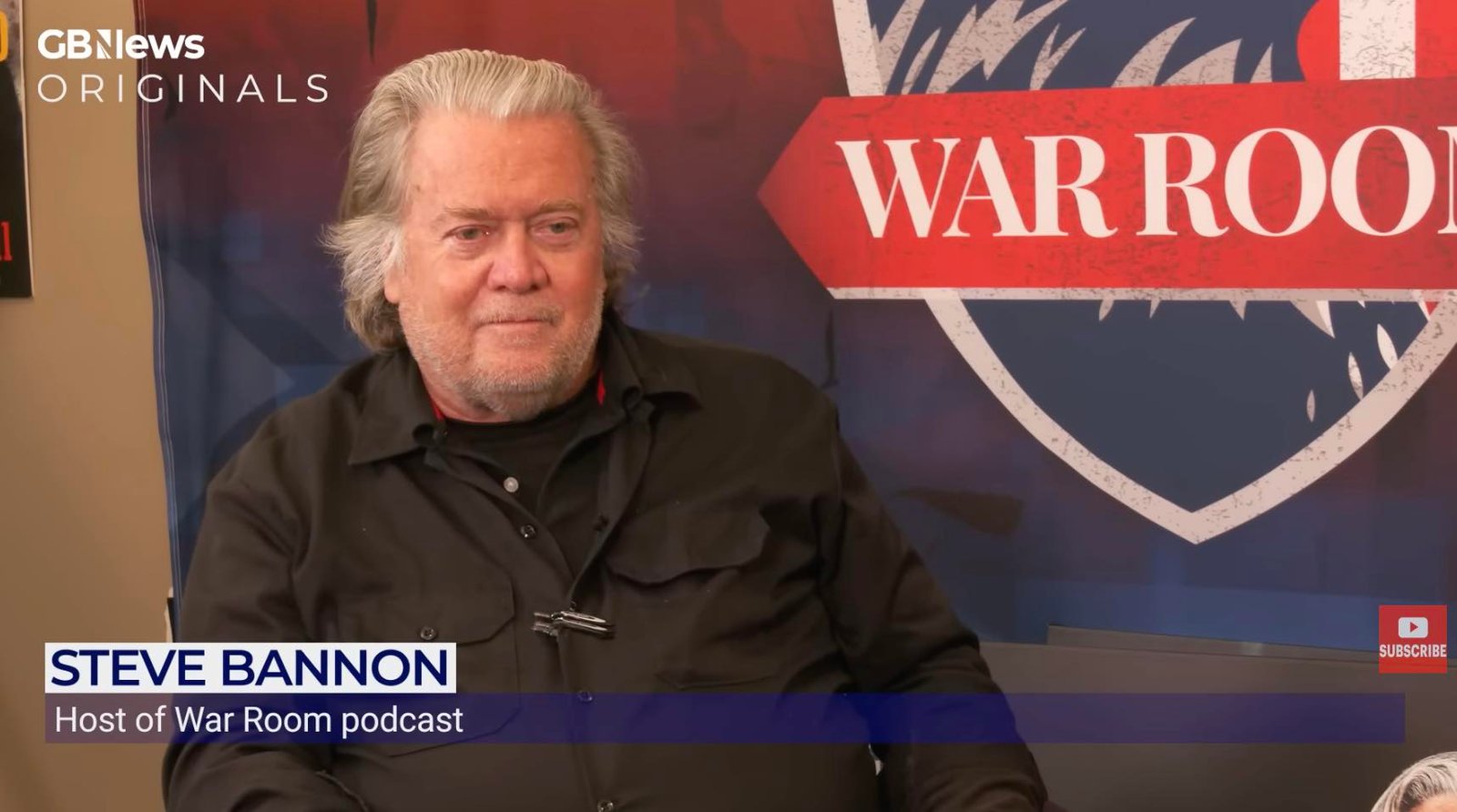
In a characteristically incendiary interview with GB News, former Trump chief strategist Steve Bannon has claimed that the UK is “heading towards a civil war” unless the country’s political establishment drastically changes course. Speaking in London following his address at the National Conservatism Conference, Bannon painted a bleak picture of Britain’s economic, cultural, and political future, warning that time is running out to avert widespread unrest.
Bannon, a close ally of Nigel Farage, heaped praise on the Reform UK leader for his role in galvanising a populist movement but suggested even Farage may not be able to prevent what he described as “some quite unpleasantness” in the months ahead. “Unless there’s a big course correction, I think England is heading towards a civil war,” Bannon said, pointing to rising tensions over immigration, economic decline, and what he characterised as an unresponsive political elite.
People are turning to Nigel Farage and Reform UK, in part because of frustration with the Labour and Green alliance, as cities like Southampton grapple with rising crime. According to the Office for National Statistics and Police.uk, Southampton has become one of the country’s hotspots for violent and sexual offences, recording rates well above those seen in similar urban areas. Independent analysis from CrimeRate.co.uk ranks Southampton as the third-highest UK city for these crimes, with 48 offences per 1,000 residents—about double the national average. With over 13,000 incidents reported in a single year, the city faces a serious and persistent struggle with violent crime.
Bannon spoke about the red-green alliance, the chilling affects which are felt in Southampton with soaring crime rates and Asylum hotels. Speaking about New York Mayor candidate Zohran Mamdani Bannon adds his “‘mother’s up to her neck in Qatar money. Mamdani is the Red-Green Alliance, which Sadiq Khan is. And look at the changes in London in the last, what, 10 years or so. So, no, we have a huge problem here.” Going on “And I tell people it’s the Red Green Alliance. It’s neo-Marxism with, you know, not jihadists, but in back of them are jihadists.”
The former White House adviser delivered a scathing assessment of Britain’s financial position, calling the country “broke” and highlighting what he claimed is a £50 billion “mystery gap” in the national budget. “You’ve now got—I think—a £50 billion gap, mystery gap, in the budget of the UK. Now the Chancellor of the Exchequer is saying it’s just a computation problem. I think she’s wrong. You’re broke,” Bannon insisted, dismissing suggestions that the issue is purely technical.
He argued that the UK, along with France and Germany, “have no military, no money, no arms, and no political will to do anything,” and claimed that the economic malaise is fuelling a populist backlash that the political system is ill-equipped to handle.
Bannon cited recent incidents of English flags being raised and then removed by authorities as evidence of “deep undercurrents” of discontent. “There’s this spontaneous populist move of putting up the English flag, right? The cross of St. George and the Union Jack, and then having them taken down by authorities. There’s something there,” he said, warning that attempts to suppress such displays only risked inflaming tensions further.
He contended that the British establishment’s efforts to limit free expression—particularly around issues of immigration and national identity—are “throwing gasoline on the fire.” “You have put in draconian laws against free speech to try to stop people from addressing this issue. That’s not gonna work, not in the modern age,” Bannon said.
Pressed on whether he saw the looming conflict as a religious or cultural clash, Bannon said, “Yes,” describing it as a confrontation between “Islamic fascists and fanaticists versus native English people,” with the British left and establishment “on the side of Islam.” He suggested that Farage, long seen as a “man of the centre-right,” is being forced by events to adopt more radical positions, including support for mass deportations—a policy Bannon boasted of championing in the US alongside Donald Trump.
Bannon likened Farage’s warnings to “a red warning light,” and argued that “things may be spinning out of control, particularly with the major economic downturn Britain’s gonna go through.”
Bannon, no stranger to polemic, reserved some of his sharpest words for Britain’s political class—lambasting the Conservatives as “hapless,” Labour as “overwhelmed by events,” and Sir Keir Starmer’s government as “feckless technocrats” out of their depth. He claimed that Britain’s core institutions, from the BBC to Parliament, are “as bad as they’ve ever been” and “not even stopping the problem right now.”
He predicted that, absent a dramatic political shift, the country will “get beyond the ability of elective politics as we know it today to solve it.”
Bannon repeatedly returned to the theme of free speech, warning that attempts to curtail debate over immigration and national identity would only radicalise opposition further. “The more you try to suppress speech, you’re just throwing gasoline on the fire,” he said. “In the modern world, you’re not gonna be able to suppress speech. Yes, you can try to be a speech Nazi and do that. It’s only gonna metastasize what you’re trying to stop.”
He drew parallels between Britain’s situation and the US, suggesting that populist movements on both sides of the Atlantic are being strengthened by establishment attempts to silence them. “We’re not trying to take anyone down,” he said of his own activities, “we’re trying to warn.”
Asked about the prospect of the economy taking down Sir Keir Starmer’s government, Bannon was blunt: “I think it’s taking it down right now.” He cited Starmer’s dwindling approval ratings and compared the current economic crisis to the one that felled Liz Truss and the Conservatives. He also predicted that Labour’s failure to address immigration and economic woes would ultimately hand power to either Sadiq Khan or, eventually, Nigel Farage.
Bannon’s final message was one of stark warning: “If you see how this thing plays out, I think it ends in civil war.” He urged the British public to heed what he described as Farage’s moderate, but increasingly urgent, warnings, and claimed that only a wholesale political realignment could avert disaster. “If you continue down that path, you’re gonna get beyond the ability of elective politics, as we know it today, to solve it.”
Whether Bannon’s apocalyptic vision comes to pass remains to be seen. But his remarks—and the enthusiastic audience his views find online—underscore the fractious and unpredictable state of British politics as the country grapples with economic crisis, identity politics, and a deepening sense of mistrust in its leaders.
- Steve Bannon will be speaking at the Unite The Kingdom rally on September 13th in London